
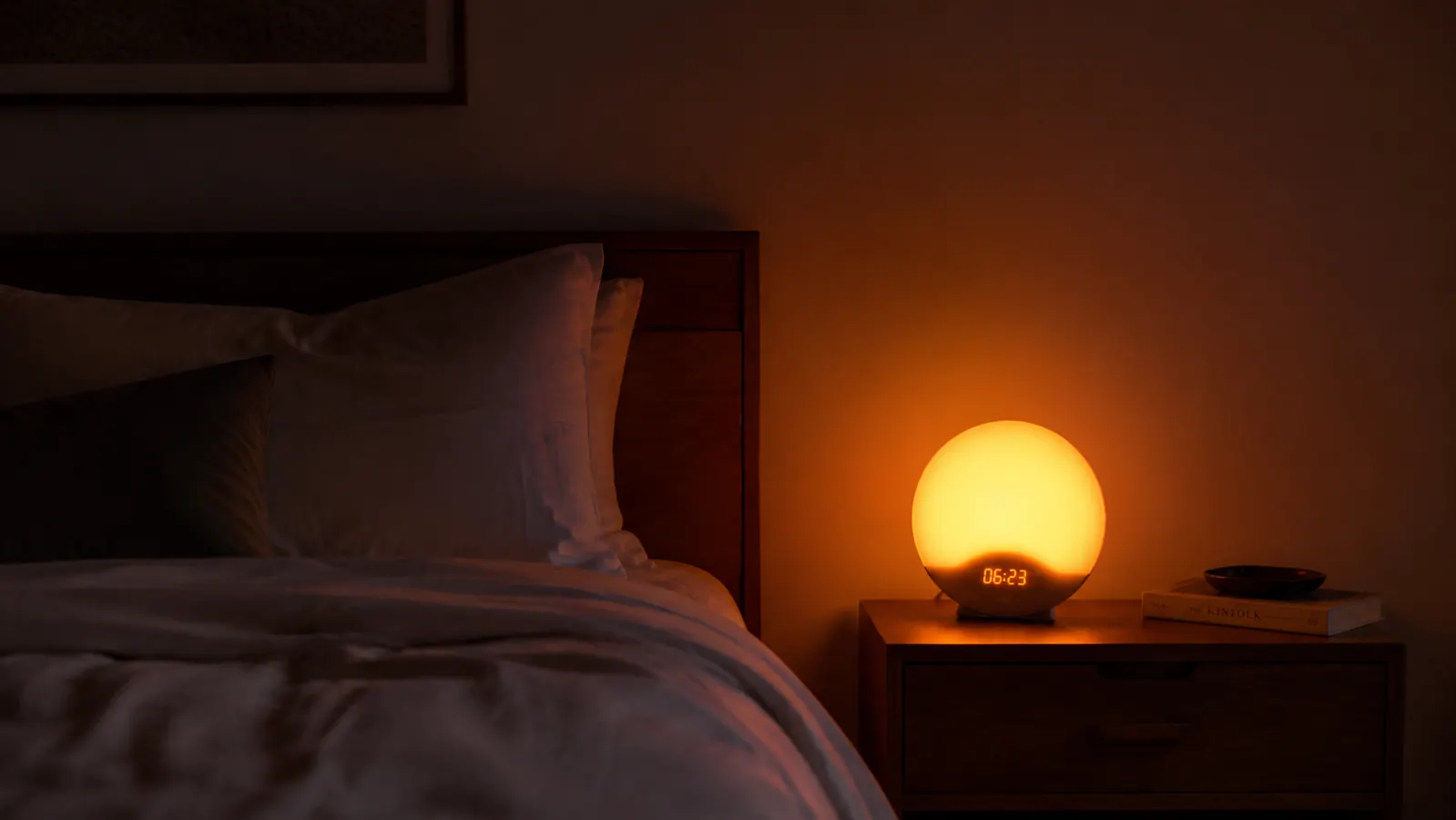
For two winters running, the first sound we heard every morning was a phone alarm screaming at full volume from six inches away. We would lurch awake, cortisol spiking, hearts pounding, already behind before our feet hit the floor. By December we had started dreading bedtime itself, because we knew what was coming at 6am. That is not a morning routine. That is a stress drill.
We had read about sunrise alarm clocks and ignored them for months. They sounded like a niche gadget for people who describe themselves as morning people. We are not morning people. But after a particularly rough January week where we snapped at everyone before 8am and still felt foggy by 10, we ordered the JALL Full-Screen Wake Up Light Sunrise Alarm Clock. It was budget-friendly. We figured if it helped even a little, it would be worth it. Ninety days later, here is what we actually found.
The Quick Verdict
The JALL sunrise clock genuinely reduces morning shock and grogginess for most people. The full-screen light is brighter than it looks in photos. The white noise function works well. The app is skippable. Not a luxury product, but a practical one that delivers on its core promise.
Amazon Check Today's Price →Still ripping yourself awake with a phone alarm? 90 days in, we are not going back.
The JALL Full-Screen Sunrise Alarm Clock uses a gradual light simulation to ease your body out of sleep before sound ever triggers. It is currently available on Amazon with over 28,000 reviews. Check current price below.
Amazon Check Today's Price on Amazon →How We Tested the JALL Sunrise Clock
We set the JALL up in a bedroom that gets zero natural light before 7:30am in winter, which is exactly the scenario these clocks are designed for. The room faces north with blackout-adjacent curtains. Before the JALL, the only light source at wake time was whatever the phone screen threw out when the alarm fired.
We ran it for 13 weeks straight. The first two weeks we used the 30-minute sunrise simulation at 20 percent brightness to calibrate. Weeks three through six we pushed brightness to 70 percent and extended the simulation to 45 minutes. Weeks seven through thirteen we settled at 60 percent brightness with a 30-minute simulation and one of the built-in bird sounds as the backup alarm. We tracked one data point subjectively every morning: a 1-to-10 grogginess score logged in a notes app within five minutes of waking. No sleep tracker, no biometrics. Just an honest self-report.
We also tested the white noise function separately for two weeks, running it overnight at a volume level that would cover ambient street noise but not wake a partner sleeping in the same room. Setup out of the box took about eight minutes, including downloading the app once and then deciding we did not need it.
The Full-Screen Light: What It Actually Looks Like in a Dark Room
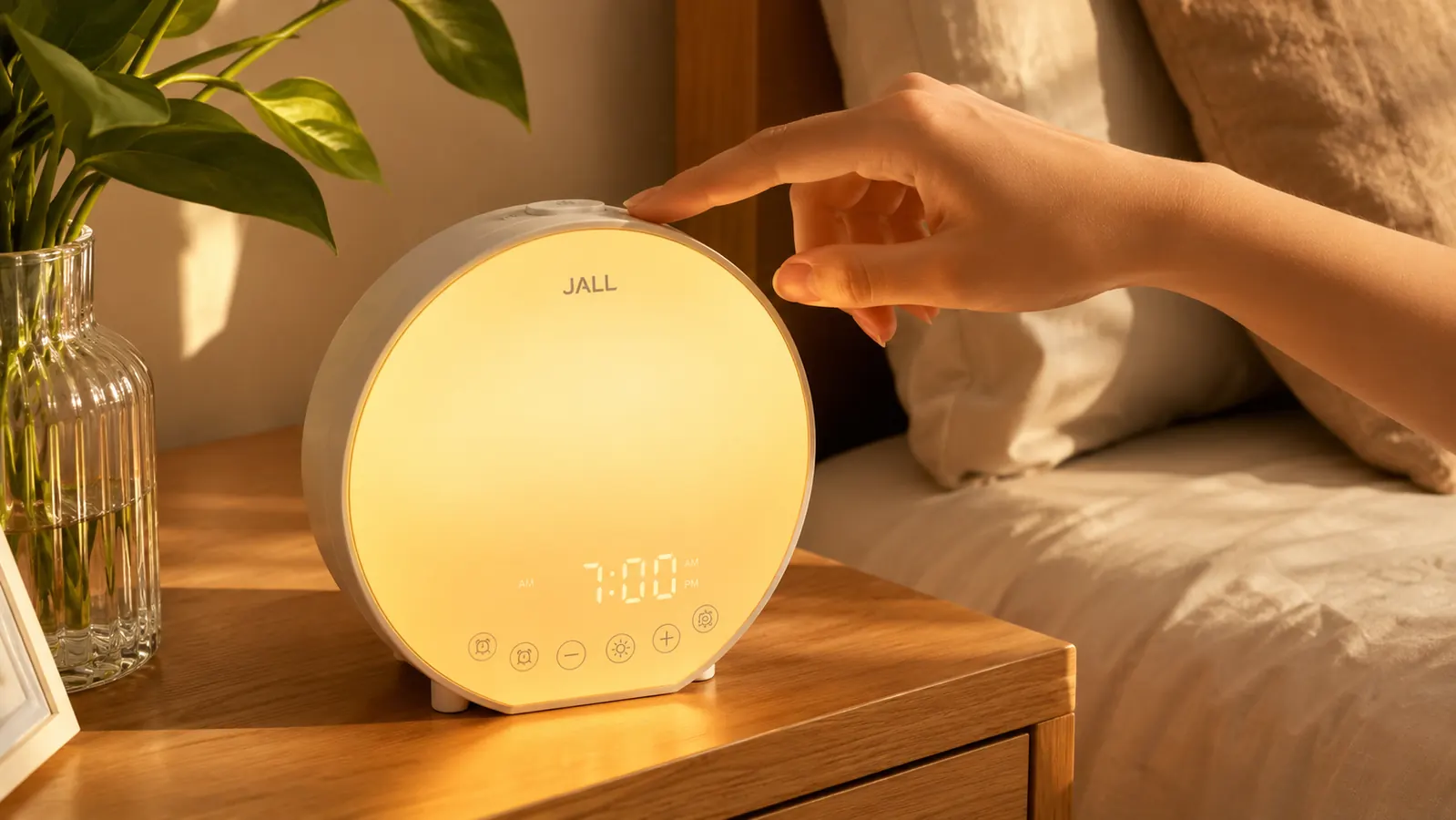
The JALL's defining feature is that the entire face of the clock lights up rather than a small lamp or a partial arc. In photos it looks modest. In a genuinely dark room at 5:45am, 60 percent brightness is more than enough to register through closed eyelids. We had expected to lie there unaware of any change and then jolt awake to sound anyway. That is not what happened.
By week three we were waking naturally during the final ten minutes of the simulation, before the backup bird sound ever fired. Not every morning. Maybe five out of seven. But enough that the 6am alarm became a formality rather than an attack. The light starts at a deep red-orange and shifts through amber toward a pale yellow-white over the simulation period. It is not solar-bright at maximum, but it does not need to be. The cue is the gradual change, not the peak intensity.
One real limitation: if you sleep with a partner who keeps different hours, the full-screen light at 60 percent is going to wake them too. There is no way to direct the light away from one side of the bed. We used a sleep mask experiment one week and found the simulation mostly lost its effect through heavy fabric. Keep that in mind if you share a bed with someone on a different schedule.
Grogginess Scores Over 90 Days: The Honest Numbers
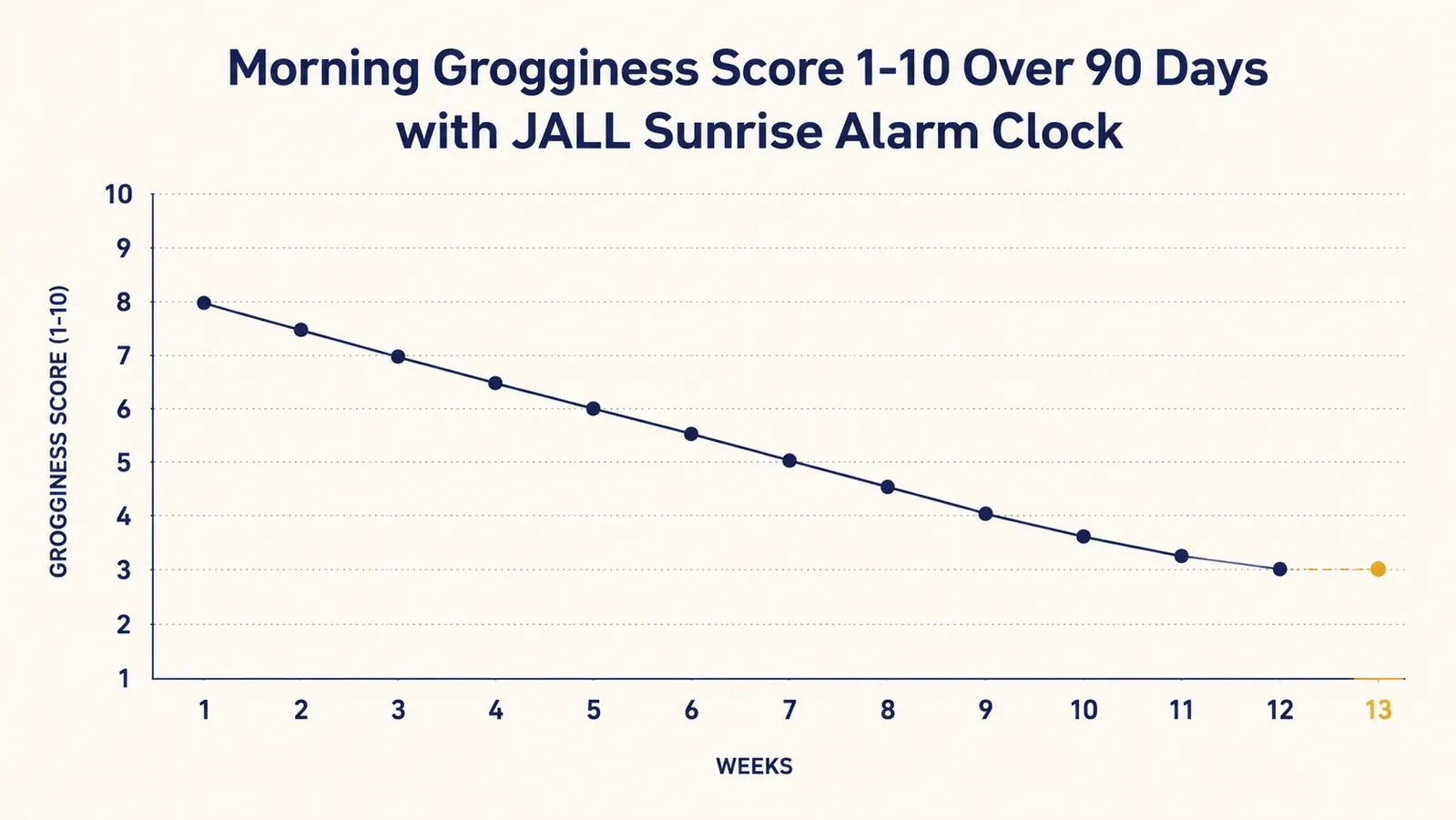
Weeks one and two, average grogginess was 7.4 out of 10. That is roughly where we started before the JALL, so no change yet. Weeks three through five dropped to 5.8. Weeks six through nine settled around 4.5. The final month averaged 3.2. That is not a scientific study. It is one person's consistent self-report across a single winter. But a drop from 7.4 to 3.2 over thirteen weeks is hard to wave away, even with all the usual caveats about placebo and expectation effects.
What we cannot say is how much of the improvement came from the light itself versus the sound change. Swapping a jarring phone alarm for the JALL's gentlest bird sound alone would probably reduce morning shock. Sunrise clocks bundle two changes at once: light simulation and softer audio. Separating their contributions would need a controlled setup we did not have. What we can say is that the combined effect was meaningful and lasted through the full three months without fading.
By week six we stopped checking the phone immediately after waking. We had not realized how much of the morning fog came from lying there in bed doom-scrolling before our feet hit the floor.
White Noise, FM Radio, and the Other Features
The JALL includes 20 sounds: white noise, brown noise, fan, rain, ocean, birds, and others. We tested white noise, brown noise, and the fan sound over two weeks each. For covering light street traffic and the occasional neighbor noise, white noise at mid-volume worked well. It is a digital recording running on a loop, and if you listen actively you can eventually hear where it loops. For sleep purposes, that does not matter. You are not listening actively.
The FM radio function is there, but we found the antenna reception in our location poor enough to make it mostly useless. The bedside USB charging port is a genuine convenience. The alarm backup sounds range from a gentle chirp to something close to a classic alarm beep if you turn the volume to maximum. The volume knob is physical, which we prefer to a touch slider. The buttons on top of the unit are tactile and easy to find in the dark without looking.
There is a companion app. We used it for initial setup and then stopped. Everything the app does, the physical buttons also do. If you dislike pairing gadgets to your phone, you can ignore the app entirely and still access every core function. The display dims automatically at night and brightens when the simulation starts, which means you are not staring at a harsh blue clock face at 2am.
Build Quality and 90-Day Durability
At a budget price point, the JALL is a budget product and it feels like one in the hand. The plastic housing is light but not flimsy. The display reads clearly from across the room. After 90 days of daily use, nothing has changed in function or appearance. No dead pixels, no buttons that have loosened, no quirks that developed over time. We have seen forum posts about units having issues with the sunrise simulation starting inconsistently after several months. We did not experience that, but it is worth noting as a long-term risk.
The clock face is large enough that the display doubles as a usable nightlight if you set the brightness very low. We used it at three percent during the night as a subtle orientation light so we could navigate to the bathroom without turning on overhead lights. That is a small thing but it became a regular habit. The power cable is fixed, not removable, which means if it fails you are not swapping a cord. That is a minor engineering complaint on an otherwise solid basic device.
What I Liked
- Full-screen light simulation is visible through closed eyelids in a dark room
- Gradual color shift from red-orange to pale yellow feels natural rather than clinical
- Physical volume knob and tactile buttons are easy to use half-asleep
- White noise function covers light ambient noise effectively
- USB charging port on the side is genuinely useful
- App is optional, not required, for any core function
- 28,000-plus Amazon reviews provide a large evidence base before you buy
Where It Falls Short
- Full-screen light will wake a partner on a different schedule
- FM antenna reception is poor in most indoor environments
- Loop point in white noise tracks is audible if you listen actively
- Budget plastic build; feels like what it costs
- Fixed power cable cannot be swapped if it fails
- Some user reports of sunrise simulation inconsistency after several months
- Maximum brightness does not approach true daylight intensity
How It Compares to a Phone Alarm and to Pricier Alternatives
A phone alarm is free. The JALL costs a modest amount. That comparison only makes sense if you actually feel better using one of them. We felt measurably better using the JALL, which makes the math easy. The real comparison worth making is between the JALL and the Philips SmartSleep Wake-Up Light, which runs considerably more. We have a full breakdown in our JALL vs. Philips SmartSleep comparison, but the short version: the Philips is meaningfully brighter and includes a clinically studied light wavelength profile. If light sensitivity is the core issue and you have the budget, Philips is the stronger tool. If you want to try the concept without spending top dollar, the JALL is a rational place to start.
There are also ten reasons the sunrise simulation approach beats a traditional alarm that we get into more deeply in this breakdown. The short version: the shock of sudden loud noise in deep sleep triggers a cortisol spike that can linger for over an hour. Light simulation works with your natural sleep cycle instead of against it. At this price point, the JALL lets you test whether that difference matters to your body before investing more.
Who This Is For
You will get the most from the JALL if you wake in a dark room (no natural sunrise, blackout curtains, north-facing bedroom), if you use a phone alarm currently and consistently feel jolted or foggy, and if you want to test the sunrise-clock concept without committing to a premium price. It also works well as a secondary white noise machine for a bedroom that already has separate alarm coverage. If you sleep alone or with a partner who wakes at the same time, the full-screen light is not a problem at all.
Who Should Skip It
If you share a bed with someone on a different schedule, the light will wake them before your alarm fires and that will create friction. If your bedroom gets strong natural light through thin curtains before your alarm time, the simulation effect will be washed out and the clock becomes just an alarm clock with a gimmick. If you are a heavy sleeper who genuinely needs a loud, jolting alarm to function, a sunrise simulation alone is unlikely to be enough and you should look at devices with stronger light intensity and louder backup sounds. And if you are considering a clinical sleep therapy device for a diagnosed circadian disorder, the JALL is not that product.
Dark winter mornings were ruining our first hour every day. The JALL did not fix everything, but it fixed the worst part.
After 90 days we have not touched the phone alarm. The JALL Full-Screen Sunrise Alarm Clock is at its current price on Amazon. Over 28,000 buyers have left reviews. Check current price using the link below.
Amazon Check Today's Price on Amazon →