
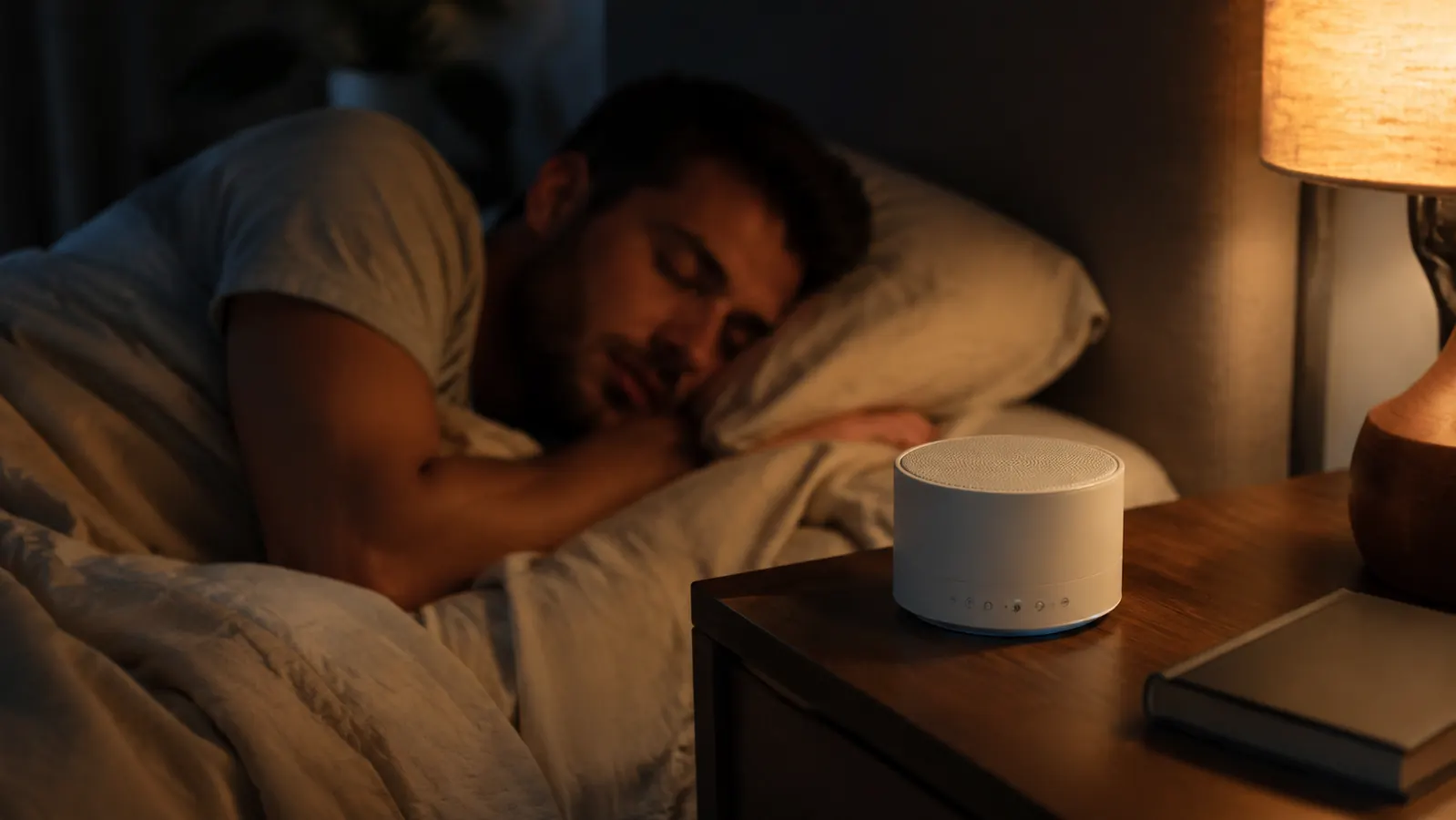
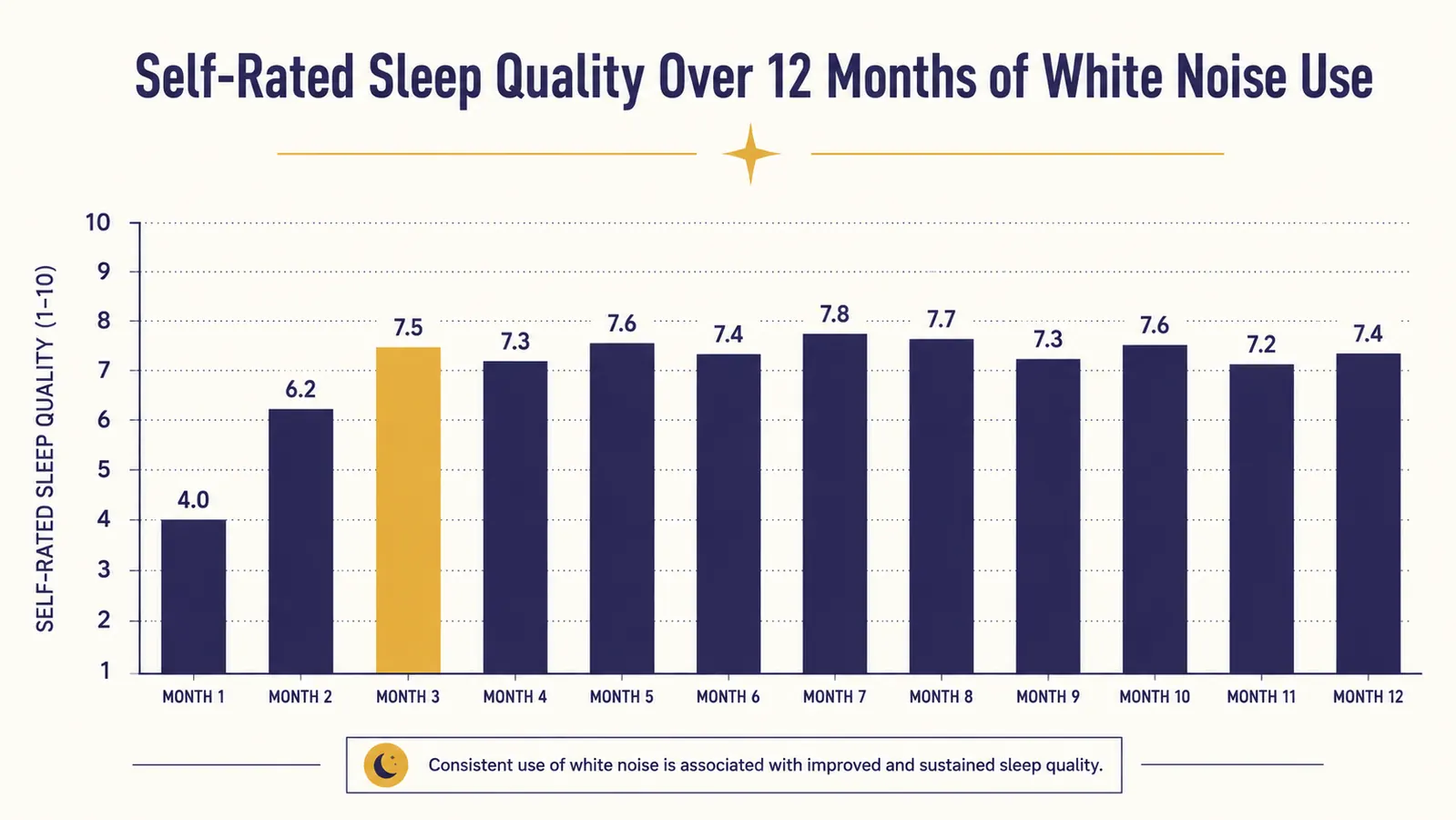
We live in a second-floor apartment on a street where the city bus stops at midnight, a neighbor watches television at conversational volume until 1am, and a dog two doors down treats every passing raccoon as a personal threat. We are also both light sleepers. Before the Magicteam white noise machine came into the bedroom, we averaged maybe five and a half hours of real sleep on a weeknight. The machine has been running every night for twelve months now, and that number is closer to seven. That is the honest summary. Everything below is the detail.
The Magicteam (ASIN B07RWRJ4XW) is a small, cylindrical digital sound machine with 20 non-looping sounds, a single volume knob, a simple timer button, and a USB power cable. It costs less than most restaurant meals and it sits on over 68,000 Amazon reviews with a 4.5-star average. We bought ours skeptically, assuming the price meant plastic junk. Twelve months later it is still on the nightstand, still working.
The Quick Verdict
For a light sleeper in a noisy apartment or a shift worker on an irregular schedule, the Magicteam punches well above its price. The sound library is broad enough to find something that works, the volume range is genuinely useful, and the build has held up a full year without issue. The knob-only interface is bare-bones, the fan sounds plateau at medium-loud, and it will not block heavy bass or a genuinely loud snorer. Those two things aside, it solves the problem it promises to solve.
Amazon Check Today's Price →If street noise or a restless partner is costing you sleep, this is the cheapest fix that actually works.
The Magicteam is affordable on Amazon with Prime shipping. At that price, one good night of sleep covers the cost.
Amazon Check Today's Price on Amazon →How We Tested It
We ran the machine every night from late June of last year through to this month. Two people in one room, one a back sleeper and one a side sleeper. The apartment is in a mid-sized city. Noise sources across the year included the bus stop outside, a rotating cast of neighbors, a full summer with open windows, and two months of street construction that started at 6:30am. We did not switch to any other sound device during this period so there is no A-B comparison night by night, but we tracked sleep hours via a basic fitness tracker and noted problem nights in a shared note.
We also ran through all 20 sounds deliberately over the first two weeks, timing how long we stayed asleep on each one before switching back. We ended up settling on Sound 3 (white noise) and Sound 7 (what Magicteam labels brown noise but sounds closer to a ceiling fan on medium speed). Those two covered about 90 percent of our nights. The remaining 10 percent were nights when the construction noise was deep enough that we switched to Sound 15, which is a low rolling brook sound, as a kind of mental override.
The 20 Sounds: What They Actually Sound Like
The product is marketed as 20 non-looping sounds, which is accurate on both counts. The sounds do not loop with an audible restart click, which was our biggest concern going in. We have used cheaper machines where the loop point was obvious enough to keep us awake. The Magicteam does not have that problem at any of the settings we used.
The first five sounds are white, pink, brown, and two fan variants. Those are the workhorses and they perform well. Sounds 6 through 12 are nature sounds: brook, rain on window, ocean waves, summer night insects, and a few others. These are higher fidelity than we expected for the price. The brook and rain sounds in particular hold up at low volume when you actually want to hear them rather than just mask something. Sounds 13 through 20 include things like a lullaby, a heartbeat, and a few ambient tracks that feel aimed at infant sleep rather than adult insomnia. We ignored those and suspect most adult buyers do too.
The honest limitation here: the fan and white noise sounds plateau around 65 to 70 decibels at maximum volume. That covers street traffic, television through a wall, and most neighbor noise. It does not cover a concrete saw at 20 feet or a partner who snores at the kind of volume that makes the nightstand vibrate. Those situations need more than this machine can give.
Volume and Placement: Where to Put It and How Loud to Run It
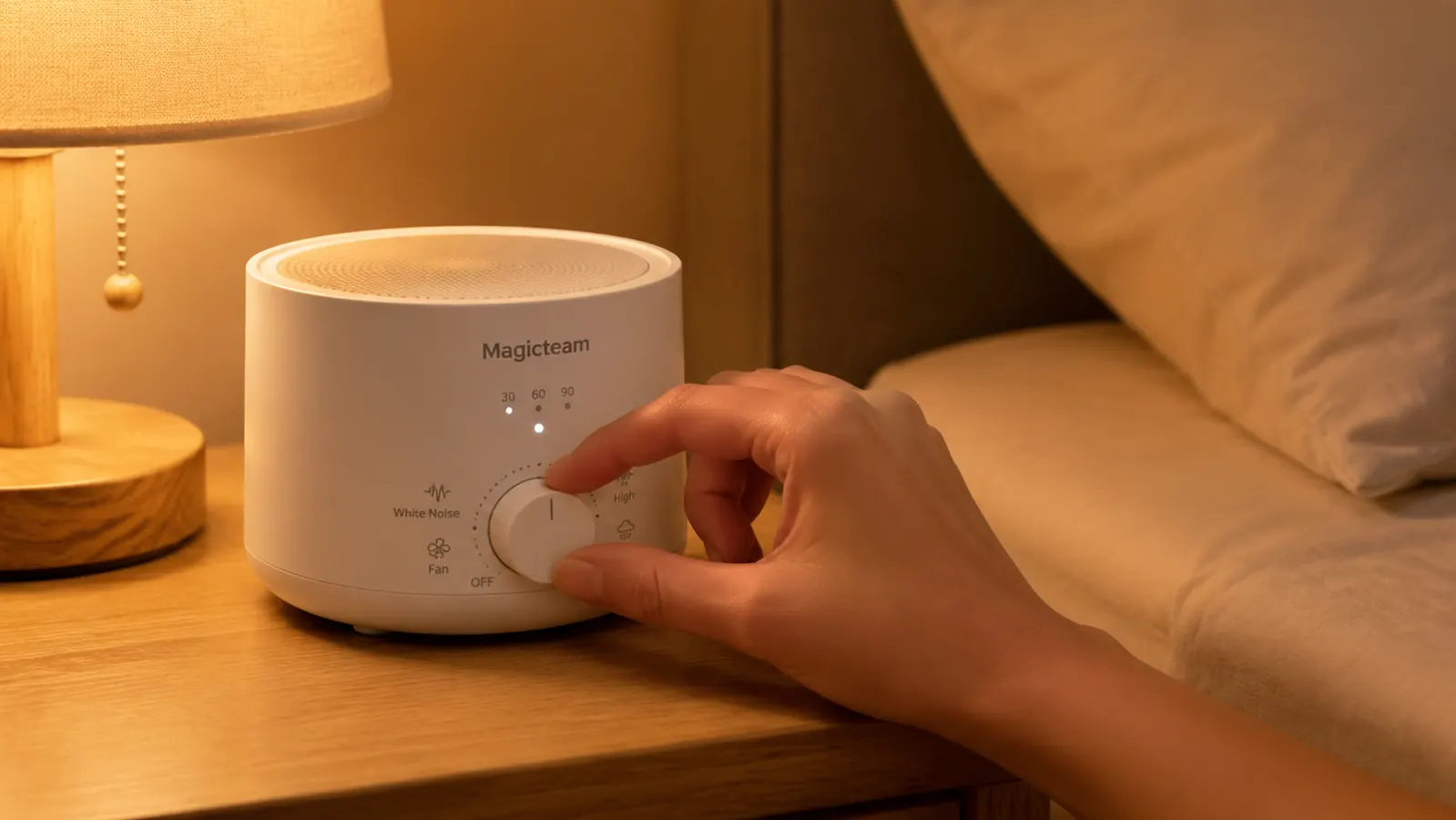
The single dial controls both sound selection and volume. Turn it to the right past the click points for each sound and the volume scales up within that selection. It is a slightly awkward interface in the dark because you can accidentally advance to the next sound when you meant to raise volume, but after a few nights you develop a feel for where your preferred sound sits on the dial. We marked our spot with a small piece of tape after month two. That fixed the problem.
Placement matters more than most reviews mention. We tested it on the nightstand at head height, on the floor across the room, and on a dresser near the door. The nightstand at head height covered the most. When we moved it across the room during the construction period, we had to raise the volume to compensate, which introduced a new problem: the sound itself became intrusive rather than masking. Our recommendation is nightstand height, roughly two feet from your pillow, at a moderate volume setting. That positioning let us run it quiet enough to feel subtle but effective.
Build Quality After Twelve Months
The machine is made of matte white plastic and feels exactly like something at this price point. It is light, the seam lines are a little rough, and the button has a slightly hollow click. None of that has changed in twelve months. What also has not changed is the speaker quality, the dial responsiveness, or the power connection. The USB cable that came in the box is still the one in use. We have not had a single malfunction.
The one physical note is that the machine gets warm on the underside during extended use. It does not get hot enough to be a concern, but do not leave it sitting on top of anything that traps heat. A nightstand surface or open shelf is fine.
The machine looks budget and it runs like it costs more. After twelve months of nightly use, the speaker still sounds clean and the dial still turns smoothly. That is more than we expected.
The Timer: Useful in Theory, Awkward in Practice
The Magicteam has a timer button that cycles through 1 hour, 2 hours, and 3 hour shutoff options, with a continuous-play setting if you hold the button. We tried the timer mode for about three weeks at the beginning and stopped using it. The machine shuts off cleanly without a click or a fade, which is fine. The problem is that if you fall asleep in 20 minutes but the noise that woke you originally happens at hour one-and-a-half, the machine has already turned off. We ended up setting it to continuous every night. That is how most long-term users probably run it.
Who This Is For
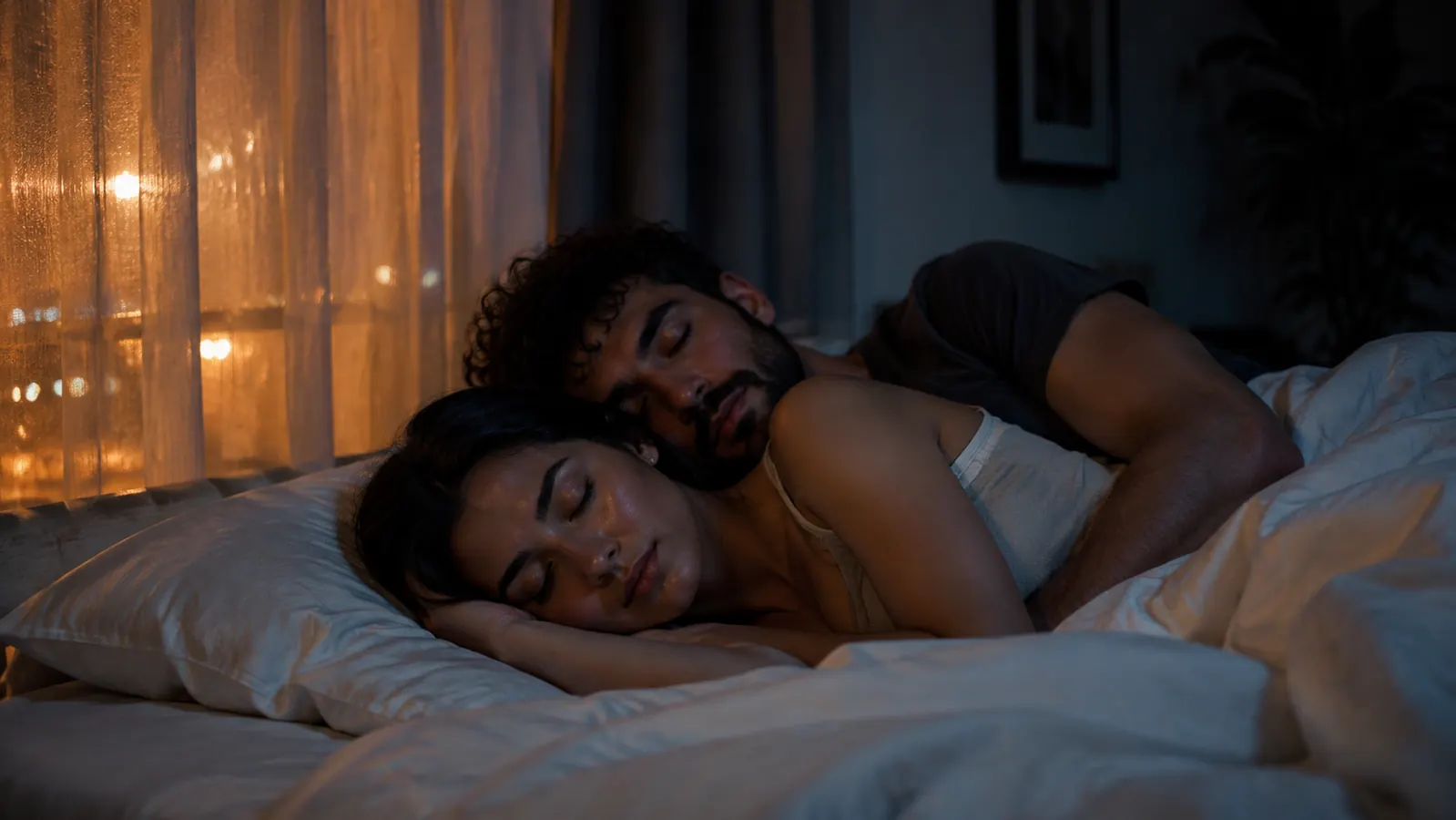
Light sleepers in apartments or shared housing will get the most from this machine. If your problem is neighbor noise, street traffic, a partner who moves around, or early morning garbage trucks, the Magicteam handles all of that at the right volume setting. Shift workers who sleep at unconventional hours and need to mask daytime household sounds are also a strong fit. The price means there is no risk in testing it.
Parents of infants who have seen the machine recommended in parenting groups: the sound quality is genuinely good and the non-looping format means no click to wake a baby. We heard from two people who bought after reading an earlier draft of these notes, and both reported it worked well for a nursery. The lullaby sounds on the upper end of the dial are soft and not electronically harsh.
If you want to compare how this machine stacks up against the Yogasleep Dohm mechanical fan, we cover that directly in our Magicteam vs Yogasleep Dohm comparison. Short version: the Dohm has a richer analog fan sound but costs three times more and has no sound variety. The Magicteam wins on flexibility and price, the Dohm wins on pure fan-sound quality.
Who Should Skip It
If you share a bed with someone who snores at a loud enough volume that you can hear it from the other side of a closed door, this machine will not be enough on its own. It masks the texture of snoring but not the peak volume spikes. You would need either a higher-output machine or earplugs used in combination. We want to be direct about this because the most common disappointed review on Amazon comes from people who expected it to handle serious snoring and found it could not.
If you travel frequently and want a sound machine for hotel rooms, the Magicteam works but the USB-only power means you need a USB outlet or a USB adapter, which is not always available in older hotels. A battery-powered alternative would serve travel use better. For a permanent spot on a nightstand, the USB cable is no issue at all.
And if the idea of choosing between 20 sounds with a physical dial in the dark sounds frustrating, it is worth noting that there is a real adjustment period. The first week we knocked the volume up accidentally twice and woke ourselves switching sounds. After about ten nights, the dial feel becomes second nature. Most people who give up on it do so in the first week. If you stick past that point, the interface stops being a problem.
What I Liked
- 20 non-looping sounds with no audible restart click
- Volume range covers street traffic, TV-through-wall, and most ambient noise
- White, pink, and brown noise options are genuinely distinct and useful
- Held up through 12 months of nightly use without any malfunction
- Brook and rain sounds are higher fidelity than expected at this price
- Compact size fits on a small nightstand without crowding it
Where It Falls Short
- Single dial interface is awkward in the dark until you learn the feel
- Fan and white noise sounds plateau around 65-70 dB, not enough for heavy snoring
- USB power only, no battery option for travel use
- Gets warm on the underside during extended use
- Upper-range sounds (lullabies, heartbeat) feel aimed at infants and skip-worthy for adults
- Timer mode shuts off too early for most full-night use cases
How It Compares to What We Used Before
Before the Magicteam we used a box fan on low speed. That is a common solution and it works reasonably well. The problem with a fan is that it moves air in summer (useful) and moves air in winter (cold). It also takes up floor space, it pulls dust if you forget to clean it, and the motor noise changes character as the fan ages. The Magicteam has none of those variables. It is exactly the same every night.
We also tried a free phone app with white noise sounds for a few weeks before buying the Magicteam. The app worked but kept the phone screen on, which bothered the side sleeper in the room, and the speaker quality on a phone face-down on a nightstand is noticeably worse than a dedicated speaker. The Magicteam's speaker is not audiophile quality but it is meaningfully cleaner than a phone speaker for this use case. For a full rundown of which situations benefit most from a dedicated machine, our 10 reasons a white noise machine helps sleep piece covers the specifics.
A year of nightly use and we would buy it again at twice the price.
The Magicteam is the lowest-friction sleep fix we have found for apartment noise. Check the current price on Amazon before it changes.
Amazon Check Today's Price on Amazon →