
When we started looking at the Magicteam white noise machine (ASIN B07RWRJ4XW), the thing we kept hearing was: it is non-looping. That phrase shows up in the product title, in the listing bullets, and in most of the positive reviews. But we wanted to know what that actually means in practice, whether it matters for real sleep, and what the 68,000-plus Amazon reviews are not saying. This is not the summary review. This is the one where we get into the parts that nobody else bothers to explain.
The Magicteam is a small digital sound machine that sells at a low price point. It has 20 sounds, a single combination dial for sound selection and volume, a timer button, and a USB power cable. That is the whole machine. If you want a full account of twelve months of nightly use and what the long-term build quality looks like, our long-term Magicteam review covers that. This review is about the specific questions that do not get answered elsewhere: the looping debate, the memory function, the snoring question, and who genuinely should not buy this.
The Quick Verdict
The non-looping claim is real, the memory function works as designed but has one frustrating catch, the sound library has a clear dividing line between useful and pointless, and it does not mask serious snoring no matter what volume you run it at. Worth buying for the right problem, a waste of money for the wrong one.
Amazon Check Today's Price →Still awake at 2am because of noise you cannot control? This is the budget fix most light sleepers overlook.
The Magicteam ships Prime on Amazon. At this price, the risk is low enough that it is worth finding out if white noise is your answer.
Amazon Check Today's Price on Amazon →The Looping vs Non-Looping Question, Actually Answered
White noise machines fall into two categories: looping and non-looping. A looping machine plays a sound file that ends and restarts. If the file is short, there is an audible click or a noticeable hiccup at the loop point. Light sleepers hear that click as a discrete sound event, and a discrete sound event at the wrong moment can pull you out of a light sleep stage. That is the problem non-looping machines are solving.
The Magicteam's 20 sounds are, according to the product, non-looping. After extensive testing across multiple sound selections, we can confirm that the white noise, pink noise, and brown noise tracks do not have an audible loop point. They blend into themselves without a seam. The nature sounds are a different matter. The ocean track has a faint rhythmic quality at the crest-and-retreat pattern that is not technically a loop click, but is noticeable enough that some people will find it repetitive at low volume. The brook sound is cleaner. The rain sound is the most seamless of the nature tracks and the one we would reach for if the core white noise options feel too clinical.
The honest answer: the non-looping label is accurate for the steady-state noise tracks (white, pink, brown, and the two fan variants) and reasonably accurate for the rain and brook sounds. If you are buying primarily for those tracks, the non-looping claim holds. If you are hoping for seamless looping on the ocean or waterfall tracks, manage your expectations.
Finding the Right Sound: What the Review Summaries Miss
Most reviews say something like: we tried it on white noise and it worked. That is not useful if white noise does not work for you, which is more common than people admit. White noise is broadband, meaning it covers the full frequency spectrum with equal energy. That makes it effective at masking a wide range of sounds, but some people find it clinical, harsh at higher volumes, or physically uncomfortable if they are sensitive to high-frequency content.
Pink noise has more energy in the lower frequencies and less at the top. It sounds warmer and softer than white noise, closer to a gentle rainstorm or a distant air conditioner. Many people who report that white noise feels grating find pink noise tolerable at higher volumes. Brown noise (sometimes called red noise) pushes even further toward the low end and sounds like a deep rumble or a shower running in the next room. It is the most physically settling of the three for some sleepers and the most disorienting for others.
The practical recommendation: start with Sound 2 (pink noise) if you have never used a white noise machine before. It is the most broadly tolerated. If it feels too light or airy, move down to Sound 3 or 4 (brown noise variants). If you need maximum masking power and the harshness does not bother you, Sound 1 (white noise) at medium volume is the strongest option. Give each sound three nights before deciding. The first night with any new sound tends to be hyperaware and unrepresentative.
The Memory Function: What It Does and the One Catch Nobody Mentions
The Magicteam is marketed as having a memory function, meaning it remembers the last sound and volume setting when you power it back on. This is accurate in the most literal sense. When you unplug the machine and plug it back in, it returns to the last dial position.
Here is the catch: the memory is mechanical, not digital. It remembers the dial position, not an internal saved state. If you physically knock the dial between uses, or if someone else touches the machine, the sound that plays when you next plug in will be whatever the dial is physically pointing to, not whatever you used last night. For a machine on a shared nightstand, this means you can reach for it half-asleep, plug it in expecting your usual brown noise, and get the heartbeat track at full volume instead. We have done this. It is not pleasant at 1am.
The fix is simple: put a small piece of tape on the dial at your preferred position. That stops accidental drift and makes the memory function actually reliable. It is a workaround for what should be a non-issue on a machine with digital controls, but the workaround takes thirty seconds and it works. Know it going in.
The memory function works exactly as described. What nobody tells you is that it remembers the dial position, not a saved setting. One accidental nudge and you are waking up to a lullaby at midnight.
Does It Actually Mask Snoring? The Honest Answer.
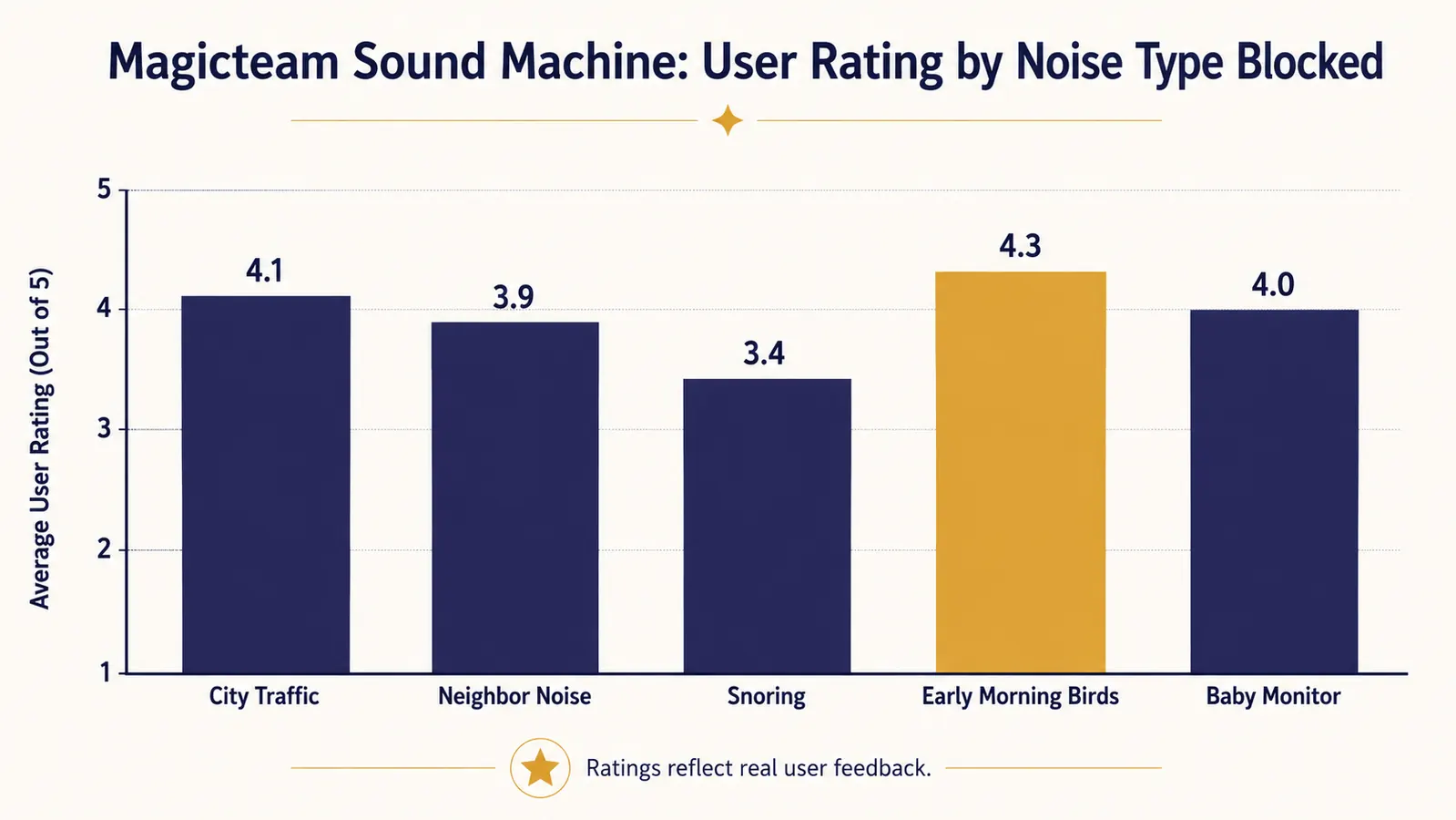
This is the most searched question about this machine and the answer is: it depends entirely on how loud the snoring is and what kind it is. The Magicteam tops out at around 65 to 70 decibels at maximum volume, depending on placement. A conversational snore in the 40-to-55 decibel range is maskable. You will hear the snoring less, and more importantly your brain registers it as a consistent background layer rather than a sharp intrusion, which reduces wake events even if you can technically still detect the sound.
Loud, variable snoring in the 65-to-80 decibel range is a different problem. The Magicteam cannot out-volume it, and turning the machine loud enough to try creates a new noise problem of its own. The snoring spikes cut through because they are rhythmically inconsistent, which is exactly what brains are wired to notice. A consistent background tone at high volume is still less disruptive than a quiet machine plus snoring spikes, but calling it masking at that point is generous.
The low-frequency component is where most machines of this type fail. Deep chest snoring produces bass energy that a small speaker cannot match. The Magicteam's brown noise option has the best low-frequency content of anything in its library, but the speaker physically cannot move enough air to produce true sub-bass coverage. For heavy snoring partners, the machine is a partial solution at best. Pairing it with foam earplugs gets you much further than the machine alone.
For a head-to-head look at how the Magicteam compares against the Yogasleep Dohm, which has a richer mechanical fan sound and slightly better low-mid frequency coverage, our Magicteam vs Yogasleep Dohm comparison breaks down which machine handles which noise sources better.
The Volume Question: What Level Is Actually Right
A common mistake with white noise machines is running them too loud. The intuition is: louder means better masking. In practice, running a white noise machine at maximum volume all night creates its own fatigue and can leave you feeling like you slept in a wind tunnel. Sleep researchers who study white noise generally recommend a range of 50 to 60 decibels at the listener's ear, which is roughly the volume of a quiet conversation across a room.
On the Magicteam dial, that range corresponds to roughly the middle third of the volume band on the current sound position. If you are turning it past three-quarters to feel like it is doing something, you are probably running it too loud and training your brain to need more over time. Start quiet. Give your brain three nights to adjust. Most light sleepers find that a moderate setting is sufficient for neighbor noise and traffic, and the machine feels less intrusive overall.
The exception is shift workers sleeping during the day who need to mask daytime sounds like deliveries, lawn equipment, and household noise. Daytime acoustic environments are louder and more varied than nighttime ones. For daytime sleep, running the machine closer to two-thirds volume and placing it between the bedroom door and the bed gives better coverage without the machine itself becoming disruptive.
What I Liked
- Non-looping claim is genuinely true for white, pink, and brown noise tracks
- Pink and brown noise options are softer and more tolerable than white noise for sensitive ears
- Memory function is reliable once you tape the dial at your preferred position
- Handles moderate snoring (under 55 dB) better than most people expect at this price
- Volume range is wide enough to use it softly without losing effectiveness
- USB power and small footprint mean it fits on a tiny nightstand without crowding
Where It Falls Short
- Memory function is mechanical (dial position), not digital, so a knocked dial ruins it
- Cannot mask heavy bass snoring regardless of volume setting
- Ocean and waterfall tracks have a faint rhythmic quality that is noticeable to sensitive ears
- Upper sounds (lullabies, heartbeat) are aimed at infants and irrelevant for adult insomnia
- Running it too loud is easy to do by mistake and counterproductive
- No app, no Bluetooth, no preset save; bare-bones interface only

Who This Is For
Light sleepers whose problem is ambient neighborhood noise, traffic, HVAC systems, or a partner who moves around in bed are the ideal buyer. The machine handles all of those situations at a moderate volume setting, costs less than most people spend on a single dinner out, and has no meaningful learning curve once you get past the first week on the dial. If you are in an apartment building with thin walls and normal neighbor noise, this machine solves most of what is keeping you awake.
People who find silence itself overstimulating, those who need some kind of ambient sound to avoid fixating on small sounds, are also well-matched here. The pink and brown noise options in particular are gentle enough to run at low volume without feeling like the machine is doing something to the room, which is the failure mode of cheaper options that sound hollow or synthetic.
Who Should Skip It
If your primary problem is a bed partner who snores at genuine volume, buy this machine and a pack of earplugs together, or start with just the earplugs. The Magicteam alone will not solve a loud snoring problem. The people who leave disappointed reviews on Amazon are almost always people who expected it to work in this scenario and found it could not.
If you are a frequent traveler, the USB-only power is a real limitation. Older hotels often have USB outlets nowhere near the bed. A battery-operated machine serves travel use better, or a phone app if you can live with the worse speaker quality. The Magicteam is a nightstand machine, not a travel machine.
If you are sensitive to the texture of sound and find white noise physically uncomfortable at any volume, this machine has pink and brown options that may work, but there is no trial period on Amazon. Know your own sensitivity before you buy. Some people find all electronic noise sources irritating regardless of frequency content, and for those people a mechanical fan or the Yogasleep Dohm's analog fan sound is genuinely a better match.
If the noise keeping you awake is ambient, not someone actively snoring next to you, this machine will likely fix it.
At the current price on Amazon, it is the lowest-stakes test of whether white noise works for your specific situation. If it does not, the cost is a non-issue. If it does, you will wonder why you waited.
Amazon Check Today's Price on Amazon →